Centuries before AI was thrust into our lives, people were grappling with how to legally protect authors. In 1709, something big happened in England: the world’s first copyright statute was enacted. The Statute of Anne was named after Queen Anne of Great Britain and granted “publishers of books legal protection for 14 years.”
Fast forward eight decades and the U.S. was modeling its own copyright law after this statute as part of the Constitution. Since then, copyright law has been amended and expanded to include creative works beyond books, like art, movies, plays, poems, and more. U.S. copyright law today also extends greater than 14 years, ensuring works are legally protected for the lifetime of the author plus 70 years.
When it comes to AI and copyright law, there have been more ethical red flags raised than consensus found. AI is trained by scouring the internet for existing content, information, sources—and that obviously includes writings, artwork, and creations from human authors and artists. Based on what it finds and learns, AI can then create its own writing, art, songs, and more.
Some questions that the U.S. Copyright Office has contended with include:
- Do copyrighted works require a human author?
- May humans copyright works that they create using AI?
- Does the AI training process infringe copyrights in other works?
- Do AI outputs infringe copyrights in other works?
To me, as a writer and creator, it does seem like AI is inherently violating copyright laws. U.S. copyright law gives authors “exclusive rights to reproduce the work in copies…” and “prepare derivative works based upon the work.” I’d argue that anything AI creates could be considered “derivative works.”
While Congress tries to sort it out – don’t hold your breath – it’s clear that authors, artists, designers, and creators need protection. And, equally as important, people who consume creative work need transparency.
Here’s a quick example that you might be able to relate to: A few weeks ago, someone sent me a video clip of Keanu Reeves talking in an interview for a podcast. It’s instantly obvious (to me) that this isn’t a real video of Keanu because the words being spoken don’t sync up with his lip movements.
But it isn’t obvious to everyone. The person who shared that video with me didn’t know it wasn’t a real video of Keanu. And as AI keeps rapidly improving, discerning the difference between real and fake videos, songs, and writing will be an uphill battle for everyone.
Let’s put a label on it
We’re starting to see some ripples of change that center transparency around human craft and creation. Take, for example, the news that came from Hollywood earlier this month where the Academy of Motion Picture Arts and Sciences announced AI protections for actors and writers. The article from NPR outlines how “the Academy says only roles performed by humans with their consent are eligible for Acting awards” and screenplays must be “human-authored.”
On a smaller scale, I’ve noticed a local radio station introduce the phrase “always human” as a bumper between songs. And at a conference I attended this spring, a graphic designer shared how they add a stamp or watermark to their work denoting it’s “human generated.”
I had fun making a few mock-ups of my own:
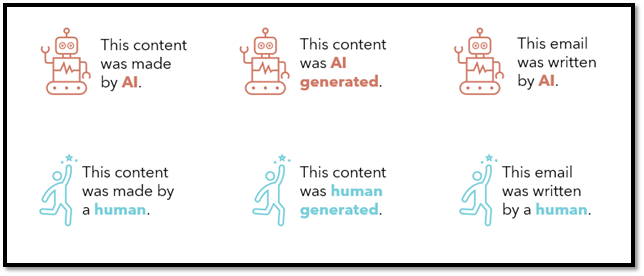
The central theme I’m seeing emerge here is the need for a label or something to denote who the writing, songs, art, videos, and more are created by. We need a third-party certification with legitimacy. We need some unifying symbol that tells other people what they’re reading, listening to, watching, consuming is authentic.
And we have plenty of examples to draw from… just look at the non-GMO movement as one. The Non-GMO Project is a nonprofit organization that was started in 2007 by two grocery stores to help consumers “decide for themselves whether to consume GMOs.” At its core, the organization believes everyone has a right to know what is in their food. And it isn’t just a label; It’s a rigorous third-party certification that only verified brands can use on their products.
I feel like this same underlying belief can be applied to AI too. Everyone has a right to know what’s in their movie, their song, their book, their email—you name it. That desire for transparency is exactly what creators need now while Congress works on the legal protection side and copyright.
While some options have sprouted up, there isn’t a clear, unanimous “winner” that’s being adopted (as far as I can tell). For example, if you simply want a “non-AI” badge on your work, websites like notbyai.fyi offer free downloads that they say can be used by artists, writers, and producers. Easy peasy, right? But there’s no certification, nothing with verification backing it up. That means anyone could use these badges, even someone who is using AI and wants to fool their audience.
Then there’s the No AI Movement, which offers two levels of participation: the No AI Declaration (again, a free declaration that anyone can use with no backing) and the No AI Certification, which is “a paid, private certification (with audit) confirming the authenticity of a declaration.” I can’t quite put my finger on it, but there’s something about this website that doesn’t feel legitimate. The strange logo that looks like two people about to kiss? The header image of an ocean that doesn’t connect with the message or website at all? Or the format of the content and writing on the homepage? (Is it just me or does it feel like it was written by AI?)
Back in March, BBC published an article about the global “race to establish an AI-free logo,” illustrating how murky the waters are on this. The article says that one of the roadblocks impeding consensus here is “getting industries to agree what truly counts as ‘human made’… as AI is integrated into so many everyday tools.”
Although self-labelling or using free badges can be problematic, they may be the best way forward for authors and artists until a clear certification approach is settled upon. And I think something that must go hand-in-hand with this is for creators to have candid conversations with their clients and audiences about where they stand with AI. Whether you’re strongly against it and never use it or if you use it selectively and in tandem with your own original work, explaining your stance and your approach upfront will allow the label to carry more weight.
Even though it feels like AI is already everywhere, I think there’s still time for us to shape and decide how we – humans – interact with AI. And there’s certainly an urgent need to do so. And as I try to wrap this up, I’m left with more questions than answers…
To my fellow writers, creators, artists, videographers, and designers, what do you think? Are you using a self-made label or have you considered it? Have you had conversations with clients about this and how did those go? Do you think AI infringes on our copyright protections? How do we protect human creators and ensure transparency without detesting AI entirely?
I’d love to hear what others are thinking and doing on this!


Leave a Reply